
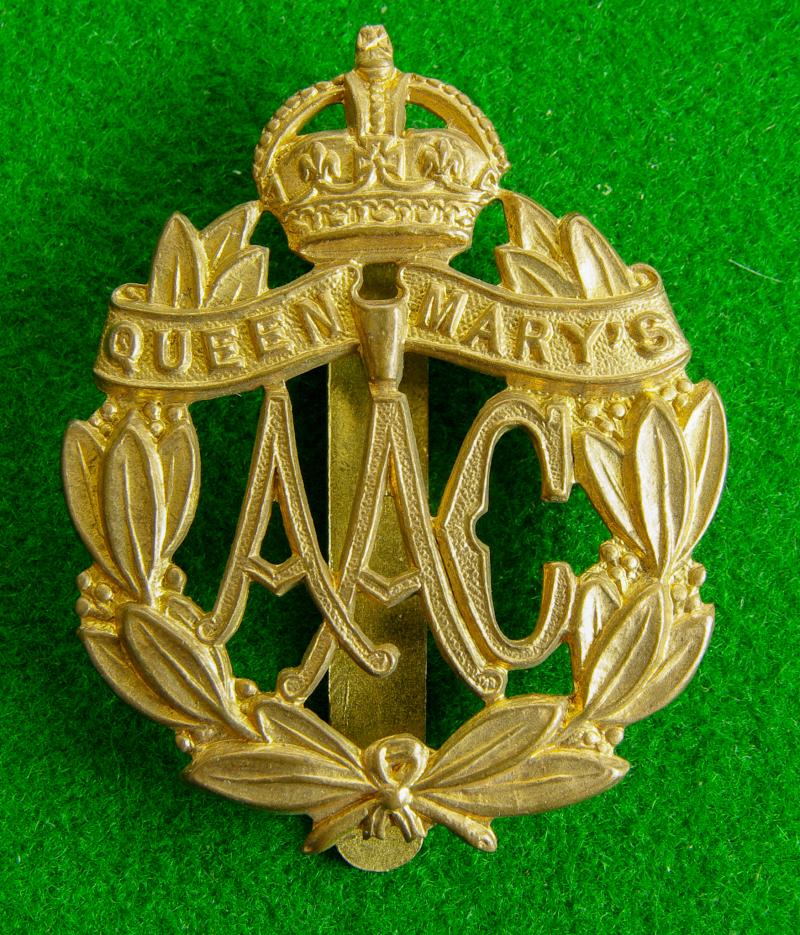
On 9 April 1918, Queen Mary became the new Commander-in-Chief of the Women’s Auxiliary Army Service (WAAC), and it was thenceforth known as Queen Mary’s Auxiliary Army Service (QMAAC). During the two years of its existence, QMAAS saw 57,000 women enter its service. It was disbanded on 1 May 1920, although a solitary unit remained in service in France until September 1921.
The original Corps had been inaugurated following the devastating loss of men during The Somme. After investigations into the work men were undertaking across the Western Front, it was identified that much of it was non-combative, work such as cooking and cleaning, background administration, and even mechanics. The Government decided that it would be more productive to engage women in these roles, hence the formation of the WAAC. By taking over these jobs, the women helped Britain send men to the Front. The majority of women served on home soil, and around seventeen thousand were dispatched to France.
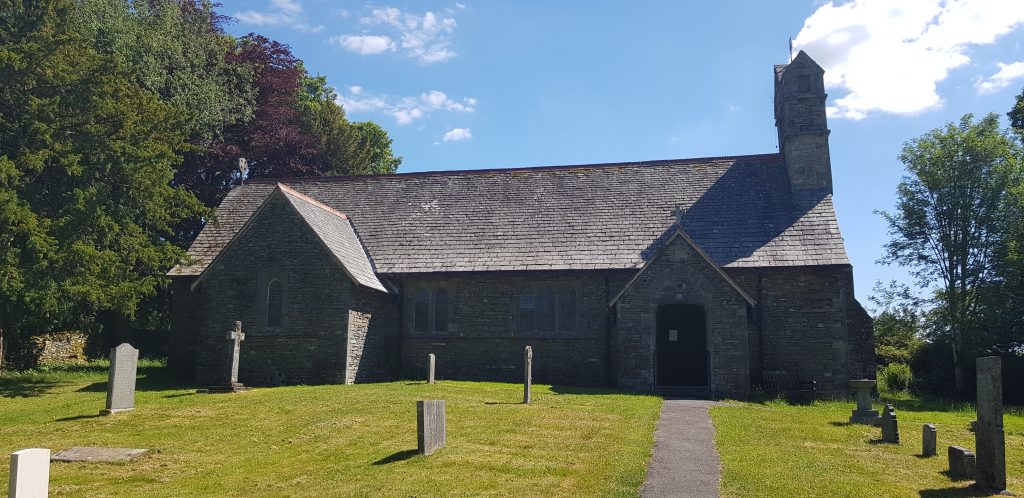
Although structured around the Army’s system, most of the women were known as Workers, an approximate equivalent to Private. Many of the women were recognised for the work they carried out as part of the Service, one such being Louise Mary Holme. On her Commonwealth War Graves Commission (CWGC) headstone in Holy Trinity Churchyard, Winster, Westmorland, it states she had been the recipient of the British Empire Medal (BEM).
During her lifetime, this medal had been known as the Medal of the Most Excellent Order of the British Empire, and was awarded for community service, voluntary work, and for those who had made a local impact. Between 1917-1922, the medal was awarded to 2,014 people, 800 of whom were from abroad.
This medal’s replacement by the BEM in 1922 was likely in no small part due to the confusion between it and the other designations within the Most Excellent Order of the British Empire – notably the officer designation: OBE (Officer of the Most Excellent Order of the British Empire).
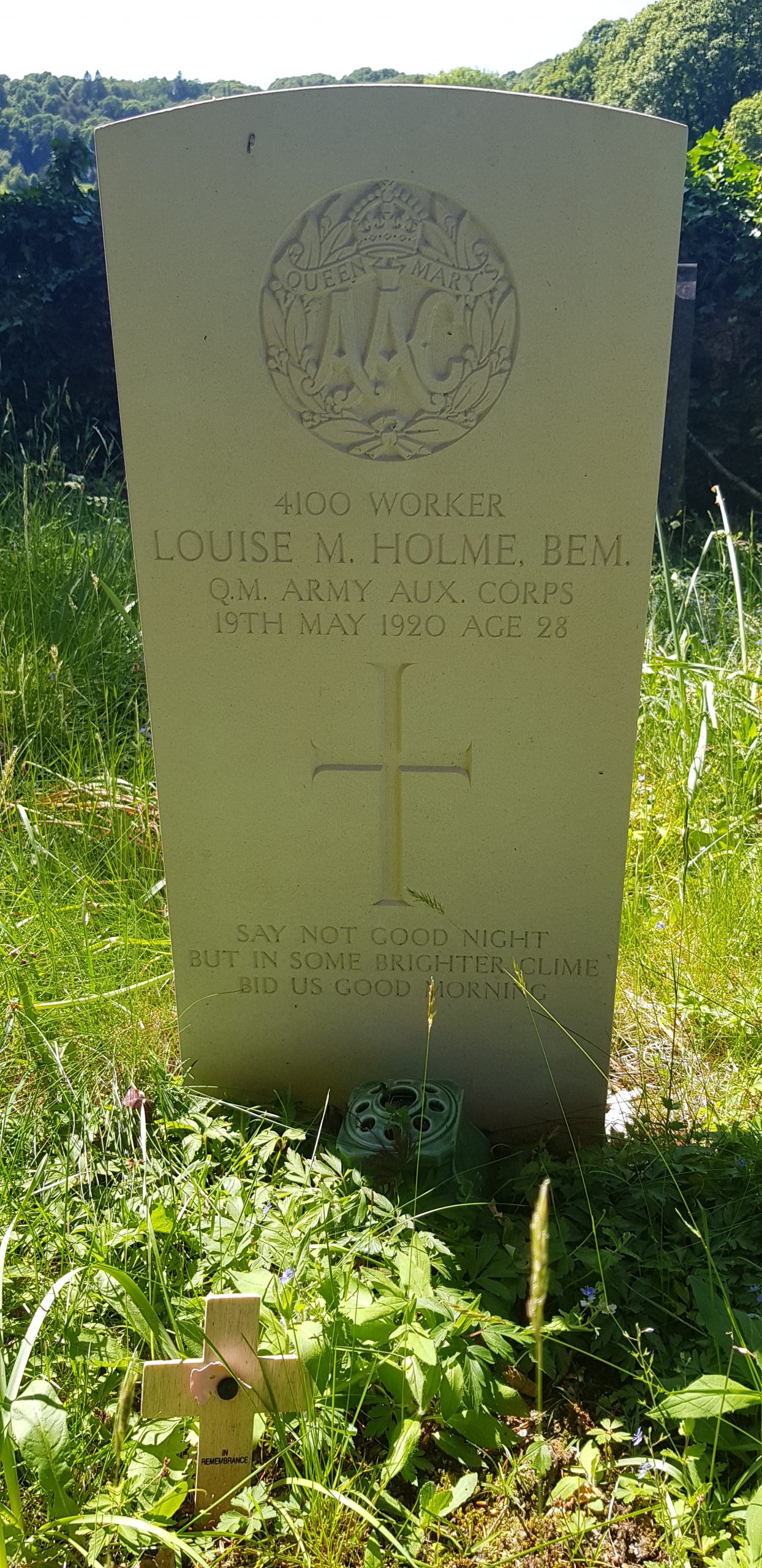
In 1925, Louise Holme’s grave in the southwest corner of the churchyard was marked with flowers. It wasn’t until after the Second World War that the CWGC began contacting all families with relatives buried in Britain to offer them a standardised headstone. So, whenever Louise’s headstone was erected, it was long after the BEM had replaced the old medal, and thus she is described as Louise M Holme, BEM.
Who was Louise? Born in Ambleside, Westmorland in December 1891, to dad John, mum Mary, she went on to have three sisters in total – Emma, Jennie, and Georgina. She and her family were living in Langdale by 1901. John was a wood carter and waggoner. In 1911, a Louise Holme from Ambleside was living with dressmaker Agnes Spalding as her assistant, at a house on Old Christchurch Road, Bournemouth, Dorset. She died on 19 May 1920 of tuberculosis, at Ninevah, the family home in Winster, her death certificate recording her as a hotel bookkeeper and ex-WAAC clerk. Only a couple of weeks or so following the disbanding of QMAAC.
As a clerk, what service had she excelled at in order to merit a medal? Unfortunately, most of the records of the QMAAC were destroyed in a bombing raid in 1940, so details of her service may be difficult to locate. CWGC headstones are erected where the person died either on active service, or due to war-related causes. As the war had been over for some time when Louise died, the tuberculosis that killed her was likely to have been contracted during her war service.
The National Archives Discovery catalogue does not have any records for Louise in its collection. Most of those that survived the 1940 air raid later succumbed to mould and damp during storage. A 2016 article in the Westmorland Gazette suggests she was a Forewoman Clerk in Folkestone, Kent, working in a hostel for servicemen returning from France.
As tuberculosis was rife in the trenches during that time, she may have caught TB from one of the soldiers, and gone on to work as a bookkeeper not knowing in the beginning that she was ill, then returned to Westmorland when she became increasingly poorly. Whilst she was recorded as a Worker by the CWGC, perhaps she was promoted to Forewoman, and this was not passed on. In which case, it’s a shame as, whatever her work entailed, we know she was exceptional enough to have been rewarded with a medal for her service to her country.
(c) Helena Sanderson 2026
Sources
Adjutant General’s Corps Museum, ‘“Les Tommettes”- Army Women of the First World War’, https://agcmuseum.org.uk/les-tommettes-army-women-of-the-first-world-war/ [accessed 14 January 2026]
Commonwealth War Graves Commission (CWGC), “Find War Dead”, https://www.cwgc.org/find-records/find-war-dead/ [accessed 14 January 2026]
General Register Office (GRO), ‘Search the GRO Indexes’, https://www.gro.gov.uk/gro/content/certificates/indexes_search.asp [accessed 14 January 2026]
National Army Museum, ‘Queen Mary’s Army Auxiliary Corps’, https://www.nam.ac.uk/explore/queen-marys-army-auxiliary-corps [accessed 25 January 2026]
Queen Alexandra’s Royal Army Nursing Corps, ‘The history of the Women’s Army Auxiliary Corps…’, https://www.qaranc.co.uk/Queen-Marys-Army-Auxiliary-Corps-History.php [accessed 14 January 2026]
The National Archives (TNA) Discovery, https://discovery.nationalarchives.gov.uk/ [accessed 14 January 2026]